Level 7: Governance & Safety
Guardrails that hold because the runtime enforces them — not because a prompt asked nicely.
What you'll learn
- Decision skills as gates:
pre_inputandpost_outputbindings, required vs advisory - Circuit breakers (
governance.limits) - Structured output (
output_schema) - A funnel on an agent: judge → revise → a human approval nobody can prompt around
- Role registries, quorum, and resolving a gate as a named person
- What the mock governance provider enforces and what it does not
The finished workspace is examples/tutorials/07-governance/. The transcripts are real runs on
OpenRouter — including one that a person had to approve.
Why governance?
"Don't answer requests for illegal activity" in a system prompt is a request the model may or may not
honour. A decision skill bound pre_input runs before the agent sees the input, and a fail
verdict ends the turn — the model never gets the message. That is the difference between a
suggestion and a gate, and it is the whole of this level.
Build it
1. A decision skill that judges input
# skills/content-filter.yaml
apiVersion: swarmkit/v1
kind: Skill
metadata:
  id: content-filter
  name: Content Filter
  description: >
    Blocks harmful, offensive or off-topic input before it reaches the agent.
category: decision
implementation:
  type: llm_prompt
  prompt: |
    You are a safety filter. The user message contains a trigger, an agent id and
    the content to evaluate. Fail it if it asks for violence, hate, illegal activity
    or exposes personal data; otherwise pass. Reply with JSON only:
    {"verdict": "pass" | "fail", "confidence": 0-1, "reasoning": "<one sentence>"}
outputs:
  type: object
  required: [verdict, reasoning]
  properties:
    verdict: { type: string, enum: [pass, fail] }
    confidence: { type: number }
    reasoning: { type: string }
provenance:
  authored_by: human
  version: 1.0.0
The runtime recognises three verdicts: pass, fail, needs-revision. Anything else is read as
pass with a warning that says the check is not running — so match the vocabulary exactly.
2. Bind it in workspace.yaml
# workspace.yaml — governance block
governance:
  provider: mock
  limits:
    max_steps_per_agent: 20
    max_steps_per_run: 100
  decision_skills:
    - id: content-filter
      trigger: pre_input          # before the agent sees the input
      scope: "*"                  # every agent; or name one
    - id: quality-check
      trigger: post_output        # after the agent answers
      scope: "*"
      required: false             # advisory: a fail is logged, not fatal
Triggers: pre_input, post_output, checkpoint (between task batches), pre_synthesis.
Every topology inherits these bindings; a topology's own governance.decision_skills can add one,
switch one off (enabled: false) or make it advisory (required: false). Under post_output, a
required fail sends the critique back to the agent for a bounded revision (config.max_retries,
default 4) before the output is passed through annotated — a decision skill never silently
drops a result.
3. Run it
  [assistant] pre_input skill 'content-filter' rejected: The content promotes illegal activity.
The content promotes illegal activity.

── run summary ──
  total events: 2
No [assistant] thinking... line: the model was never called. A benign input goes through both
gates, and the audit log carries each verdict on its row:
| event | skill | trigger | verdict | reasoning |
|---|---|---|---|---|
decision.evaluated |
content-filter | pre_input | pass | The request asks for factual information without harmful intent. |
decision.evaluated |
quality-check | post_output | pass | The response is clear, accurate, and complete … |
4. Circuit breakers
governance.limits is enforced at every node entry and on every model call: a run past
max_steps_per_run (default 500) or an agent past max_steps_per_agent ends with
CircuitBreakerError naming the limit — never a silent timeout. max_cost_per_run_usd counts
provider-reported cost.
5. Structured output
# topologies/analysis.yaml (excerpt)
    output_schema:
      type: object
      required: [findings, confidence, recommendation]
      properties:
        findings: { type: array, items: { type: string } }
        confidence: { type: number, minimum: 0, maximum: 1 }
        recommendation: { type: string, enum: [approve, reject, needs-review] }
The compiler validates the agent's answer against this and corrects field-level misses before any judge sees it. It is the cheapest gate there is — deterministic, no model call — and it is what kills shape-level hallucination (Validating a topology's output).
6. A funnel: judge, then people
A decision skill can say fail; only a person can say approved. A funnel packages both:
# roles/leads.yaml
apiVersion: swarmkit/v1
kind: RoleRegistry
metadata:
  id: leads
  name: Approval leads
roles:
  - id: engineering-lead
    members: [alice]
    scopes: [design:approve]
  - id: product-lead
    members: [bob]
    scopes: [design:approve]
# funnels/design-gate.yaml
apiVersion: swarmkit/v1
kind: Funnel
metadata:
  id: design-gate
  name: Design gate
  description: Judge the analysis, then two leads sign off.
judge:
  skill: quality-check            # a decision skill; below threshold retries with the critique
  threshold: 0.8
  max_retries: 1
approve:                          # required — the only exit
  rules:
    - scope: design:approve
      roles: [engineering-lead, product-lead]
      quorum: all
  min_distinct_approvers: 2
provenance:
  authored_by: human
  version: 1.0.0
# topologies/analysis.yaml (excerpt)
agents:
  root:
    id: analyst
    role: root
    archetype: writer
    funnel: design-gate
design:approve is conferred by a role in the registry. No agent can hold it, whatever its prompt
says — approval scopes are reserved for human identities by the policy engine.
swarmkit run . analysis --input "Should we migrate the billing service to the new payments provider this quarter?"
[analyst] thinking... (deepseek-chat-v3-0324)
[analyst] done (10.8s)
[analyst] thinking... (deepseek-chat-v3-0324)
[analyst] done (6.8s)
⏸ Review deferred: gate '2bffc79e-…:analyst' awaits approval — role-tasks opened on the review queue
  1. Approve: swarmkit review approve <id> .
  2. Resume:  swarmkit run . analysis --resume
The analyst answered; the judge scored it below threshold and the agent revised once (the second
thinking...); the approve layer opened one role-task per role and parked the run —
checkpointed, nothing resident. The process exited.
7. People decide
  mpa-2bff  analyst          multi-party-approval     role=engineering-lead scope=design:approve
  mpa-2bff  analyst          multi-party-approval     role=product-lead scope=design:approve
pending  2bffc79e-abde-4047-93da-95655334d6d4:analyst
  funnel design-gate on analysis/analyst
  pending            engineering-lead (design:approve)
  pending            product-lead (design:approve)
  waiting on: engineering-lead (design:approve), product-lead (design:approve)
swarmkit review resolve mpa-2bffc79e-…:analyst-0-engineering-lead --as alice --approve -m "Migration plan is sound." .
swarmkit review resolve mpa-2bffc79e-…:analyst-0-product-lead --as carol --approve .
✓ Approved … as alice (role=engineering-lead, scope=design:approve)
carol may not resolve …-product-lead: carol is not a member of role product-lead
The identity is checked against the registry, not trusted. Bob, who is a product lead:
swarmkit review resolve mpa-2bffc79e-…:analyst-0-product-lead --as bob --approve -m "Ship it." .
swarmkit review gate 2bffc79e-abde-4047-93da-95655334d6d4:analyst .
approved  2bffc79e-abde-4047-93da-95655334d6d4:analyst
  approved           engineering-lead (design:approve) by alice
  approved           product-lead (design:approve) by bob
Resuming from checkpoint: 2bffc79e-abde-4047-93da-95655334d6d4
{
  "confidence": 0.7,
  "findings": [
    "The request lacks specific data on current billing service performance",
    "No details provided about the new payments provider's capabilities",
    …
  ],
  "recommendation": "needs-review"
}
The same inbox in the portal — Gates lists every parked run's role-tasks, and the job page shows
the run deferred with the gate it waits on and a Resume button for when it is satisfied:
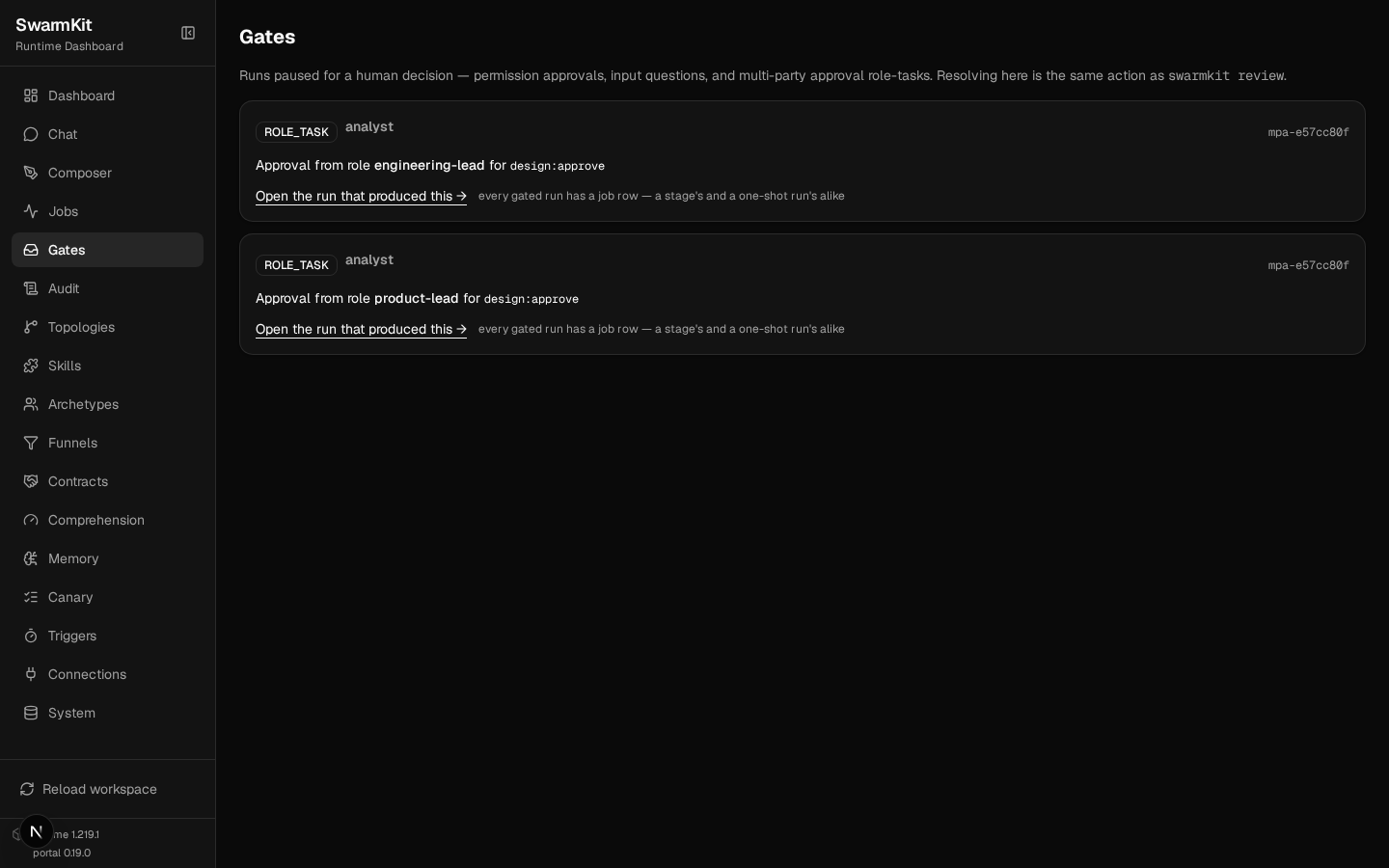
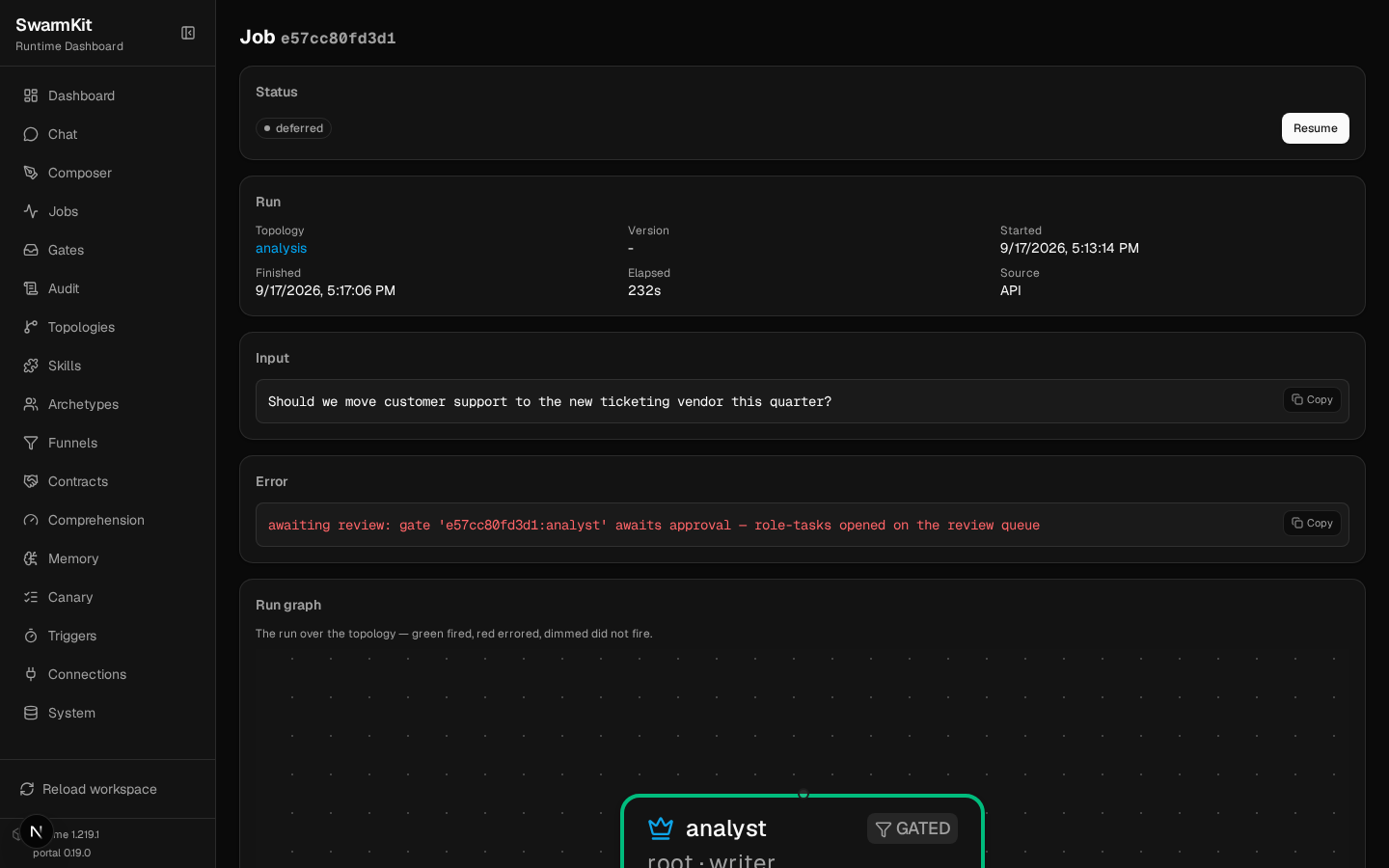
Under swarmkit serve, a satisfied gate resumes its run on its own — nothing has to call resume.
What the mock provider enforces
governance.provider: mock is the learning default, and it is honest about its reach:
| Enforced by mock | Not enforced by mock |
|---|---|
| Decision-skill gates (they run the skill) | IAM scopes — iam.base_scope on an agent and iam.required_scopes on a skill are evaluated by the provider, and the mock allows every scope |
MCP permission tiers (readonly denies undeclared effects, strict requires approval — Level 5) |
Policy files |
| Circuit breakers | |
| Funnels and role registries (identity is checked against the registry) |
Scope enforcement needs provider: agt with a policies_dir — Microsoft AGT's policy engine and
identity registry. Configure it when scopes matter; the artifacts do not change.
Your workspace so far
my-swarm/
├── workspace.yaml          # governance: limits + decision_skills
├── funnels/
│   └── design-gate.yaml
├── roles/
│   └── leads.yaml
├── skills/
│   ├── content-filter.yaml
│   └── quality-check.yaml
└── topologies/
    └── analysis.yaml       # output_schema + funnel
Next
Level 8: Observability — trace what your agents are doing, detect drift, and debug failures.