Level 6: Structured Delegation
Move from "delegate and hope" to a plan the runtime executes: coordinators write task plans, workers run them in dependency order, and a synthesis step writes the answer from every result.
What you'll learn
- Task plans and scopes — the tools a coordinator gets when it has several children
- Two-phase planning (research → scope → targeted tasks) and
scope_required - Dual model: one model for the tool loop, another for the words
- Synthesis configuration — a single-context pass over every result
- Run state on disk,
swarmkit checkpointsand--resume
The finished workspace is examples/tutorials/06-structured-delegation/. The transcript is one real
run on OpenRouter: about 300 s, 13 model calls, $0.02.
Why structured delegation?
In Level 4 the coordinator wrote a plan because it had two independent children — you saw
create-task-plan in its tool list. This level turns the knobs on that machinery:
- the coordinator creates a plan with named, ordered tasks; the runtime dispatches them
- independent tasks run in parallel; dependent tasks wait
- the plan and every result are saved to disk as they happen, so a crashed run resumes
- a synthesis pass reads every result in one context and writes the document
Build it
1. A topology with planning and synthesis
# topologies/structured-review.yaml
apiVersion: swarmkit/v1
kind: Topology
metadata:
  name: structured-review
  version: 0.1.0
  description: >
    Coordinator creates a task plan, workers execute in parallel,
    results are synthesized into a final review.
runtime:
  planning:
    scope_required: true
    two_phase: true
  synthesis:
    provider: openrouter
    model: deepseek/deepseek-chat-v3-0324
    prompt: |
      You are synthesizing a code review from several specialists.
      Combine their findings into one actionable review, critical issues first:
      ## Critical issues
      ## Recommendations
      ## Summary
agents:
  root:
    id: review-coordinator
    role: root
    archetype: coordinator
    prompt:
      system: |
        You are a code review coordinator. When given code to review, plan the
        review as tasks for your specialists, then synthesize their findings.
        Specialists: security-reviewer (vulnerabilities), quality-reviewer
        (patterns, naming, error handling), test-reviewer (coverage).
    children:
      - id: security-reviewer
        role: worker
        archetype: researcher
        prompt:
          system: |
            You are a security reviewer. Analyze code for injection, XSS/CSRF,
            hardcoded secrets and insecure dependencies. Return a structured list
            of findings, five at most.
      - id: quality-reviewer
        role: worker
        archetype: researcher
        prompt:
          system: |
            You review code quality: architecture, DRY, error handling, naming.
            Return a structured list of findings, five at most.
      - id: test-reviewer
        role: worker
        archetype: researcher
        prompt:
          system: |
            You review test coverage: critical paths, edge cases, test quality.
            Return a structured list of findings, five at most.
planning.scope_required: true— the coordinator mustcreate-scopebefore anything is synthesized; synthesis is blocked until a scope exists.planning.two_phase: true— phase 1 (research tasks) → scope → phase 2 (targeted tasks). The compiler injects the checkpoint between them; the prompt does not have to.synthesis— when set, the compiler adds a final step that loads every task result into one context and asks the named model to write the document with this prompt. The coordinator does not have to hold everything in its head.
2. Dual model on the coordinator
# archetypes/coordinator.yaml — model block
  model:
    provider: openrouter
    name: deepseek/deepseek-chat-v3-0324   # the model that writes the answer
    temperature: 0.3
    tool_provider: openrouter
    tool_model: moonshotai/kimi-k2.5        # the model that drives the tool loop (plans, reads results)
The first call of a turn goes to name; the tool-loop turns that follow — planning, reading
results, creating the scope — go to tool_model. Put the cheap, tool-reliable model on the loop
and the model you want writing on name. --verbose prints tool model: kimi-k2.5 when the
switch happens.
3. Run it
swarmkit run . structured-review \
  --input 'Review this Python function: def login(user, pwd): return db.query(f"SELECT * FROM users WHERE name={user} AND pass={pwd}")' \
  --verbose
[review-coordinator] thinking... (deepseek-chat-v3-0324)
  tools: ['create-task-plan', 'read-task-result', 'create-scope', 'read-scope']
  tool_calls: ['create-task-plan']
[review-coordinator] created task plan: 3 tasks
[review-coordinator] executing task batch: security-review, quality-review, test-review
[security-reviewer] thinking... (kimi-k2.5)
[quality-reviewer] thinking... (kimi-k2.5)
[test-reviewer] thinking... (kimi-k2.5)
[quality-reviewer] done (49.6s)
  task 'quality-review' completed (5 findings)
[test-reviewer] done (71.0s)
  task 'test-review' completed (5 findings)
[security-reviewer] done (117.5s)
  task 'security-review' completed (5 findings)
[review-coordinator] thinking... (deepseek-chat-v3-0324)
  [review-coordinator] tool model: kimi-k2.5
[review-coordinator] scope created: 7 requirements, 4 constraints
[review-coordinator] created task plan: 4 tasks
  Auto-fixed: task 'write-review-document' (self) now depends on [security-review, quality-review, test-review]
[review-coordinator] executing task batch: write-review-document
  task 'write-review-document' completed (5 findings)
[synthesizer] loading all results for single-context synthesis...
[synthesizer] 4 results, 15,895 chars total context. Calling deepseek/deepseek-chat-v3-0324...
[synthesizer] tokens: 3,506 in / 861 out / 4,367 total (37.6s)
[synthesizer] done. Output: 3,594 chars.
# **Code Review Synthesis: Python Login Function**

## **Critical Issues**

1. **SQL Injection Vulnerability (Critical)**
   - Current implementation uses f-string interpolation …
   - **Fix:** Replace with parameterized queries …
2. **Plaintext Password Storage (High Severity)** …
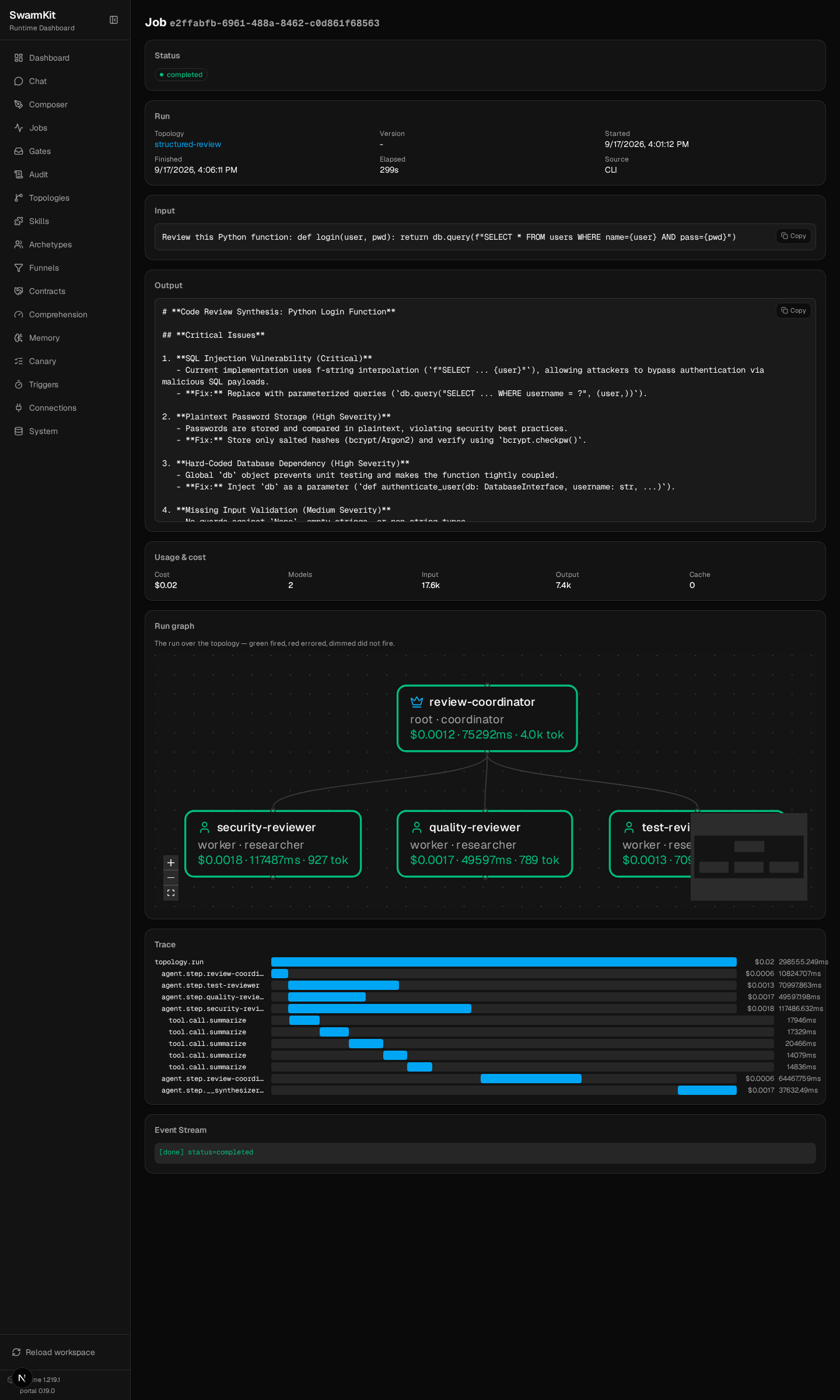
Read the sequence: three tasks in one batch, dispatched together (the three thinking... lines are
adjacent; the durations overlap); the scope written after the research phase, as two_phase
requires; a self-task the planner auto-wired to depend on all three reviews so it ran last; then
the synthesizer, in one call, over every result.
4. Read it back
Total tokens: 24,977 (input: 17,603 / output: 7,374) across 13 LLM call(s)

Agent Call Graph:
review-coordinator (deepseek/deepseek-chat-v3-0324), 1,753 tokens
  └─→ test-reviewer (moonshotai/kimi-k2.5), 627 tokens
  └─→ quality-reviewer (moonshotai/kimi-k2.5), 789 tokens
  └─→ security-reviewer (moonshotai/kimi-k2.5), 927 tokens
    ├── summarize ✓ (17946ms)
    …
review-coordinator (deepseek/deepseek-chat-v3-0324), 2,269 tokens
__synthesizer__ (deepseek/deepseek-chat-v3-0324), 4,367 tokens

Tokens by model:
  deepseek/deepseek-chat-v3-0324              8,389 (in: 7,232 / out: 1,157)
  moonshotai/kimi-k2.5                       16,588 (in: 10,371 / out: 6,217)
The portal's job page shows the same run: the run graph with cost and tokens per node, and the trace as a timeline — three parallel bars for the reviewers, the synthesizer last:
5. What is on disk, and resuming
Every plan, scope and result is written under .swarmkit/run-state/<run-id>/ as it happens:
.swarmkit/run-state/e2ffabfb-696…/
├── tasks.json            # the plan and each task's status
├── scope.json
├── security-review.md    # one file per task result
├── quality-review.md
├── test-review.md
├── write-review-document.md
└── synthesis-output.md
A run that dies mid-plan resumes from that record rather than from zero:
Last checkpointed run: e2ffabfb-6961-488a-8462-c0d861f68563

Checkpointed threads (1):
  e2ffabfb-6961-48...  6 steps ← resumable

Resume: swarmkit run . <topology> --resume
Planning modes
| Config | Behaviour |
|---|---|
| (none) | With ≥2 independent children the coordinator still gets plan tools; nothing is enforced |
scope_required: true |
create-scope must happen before synthesis |
two_phase: true |
research → scope → targeted tasks, with the checkpoint injected by the compiler |
synthesis: |
a final single-context pass over every result, by the named model and prompt |
Your workspace so far
my-swarm/
├── archetypes/
│   └── coordinator.yaml           # now dual-model
└── topologies/
    └── structured-review.yaml     # planning + synthesis
Next
Level 7: Governance & Safety — add guardrails that prevent agents from going wrong.