SwarmKit
The open-source AI platform runtime.
Define agents, tools and governance as data, not code. SwarmKit runs them under real gates, records every step, and grows them — from a single agent to a multi-agent swarm — through a portal, a CLI and an HTTP API that ship together.
A swarm is a file
Ten agents, three leaders, tools, a human gate on deployment — and no Python. Change the structure and you edit configuration, not code. Every artifact is open YAML any conformant runtime can run, and the portal edits the same file you would.
The runtime compiles it to a LangGraph StateGraph, starts the MCP servers it needs, enforces the governance you declared, and hands you a run you can replay.
# A complete code review swarm.
apiVersion: swarmkit/v1
kind: Topology
metadata:
  name: code-review
agents:
  root:
    id: supervisor
    archetype: supervisor-leader
    children:
      - id: engineering-leader
        archetype: engineering-leader
        children:
          - id: code-reviewer
            archetype: code-analyst
            skills: [code-quality-review, security-scan]
          - id: github-reader
            archetype: github-reader
            skills: [github-pr-read]
      - id: qa-leader
        archetype: qa-leader
        children:
          - id: test-analyst
            archetype: test-analyst
            skills: [test-coverage-review, run-tests]
What you get
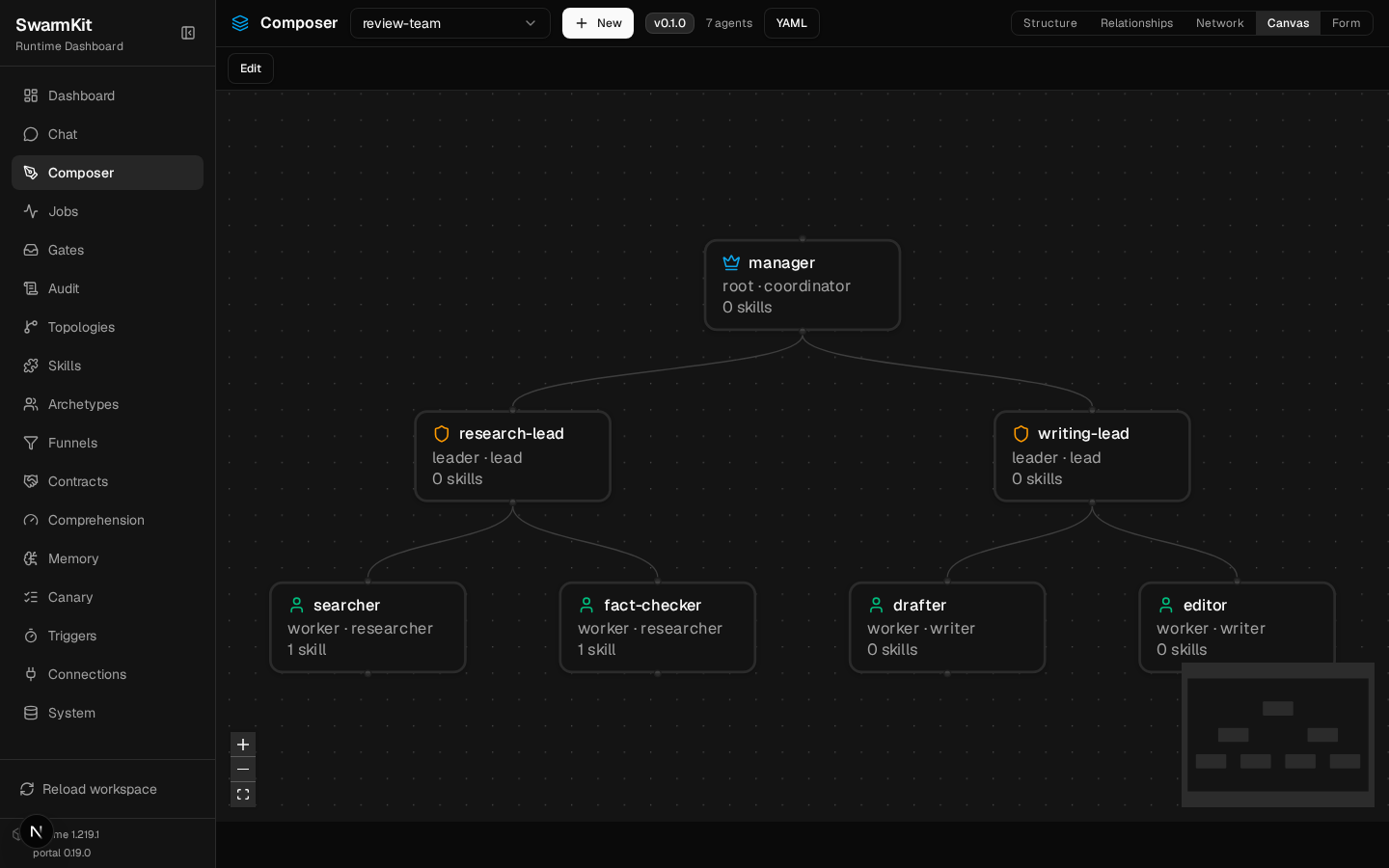
Topologies you can see
Hierarchies, parallel workers, DAG dependencies — drawn from the YAML on the canvas, edited as a form or as the file. Multi-agent →
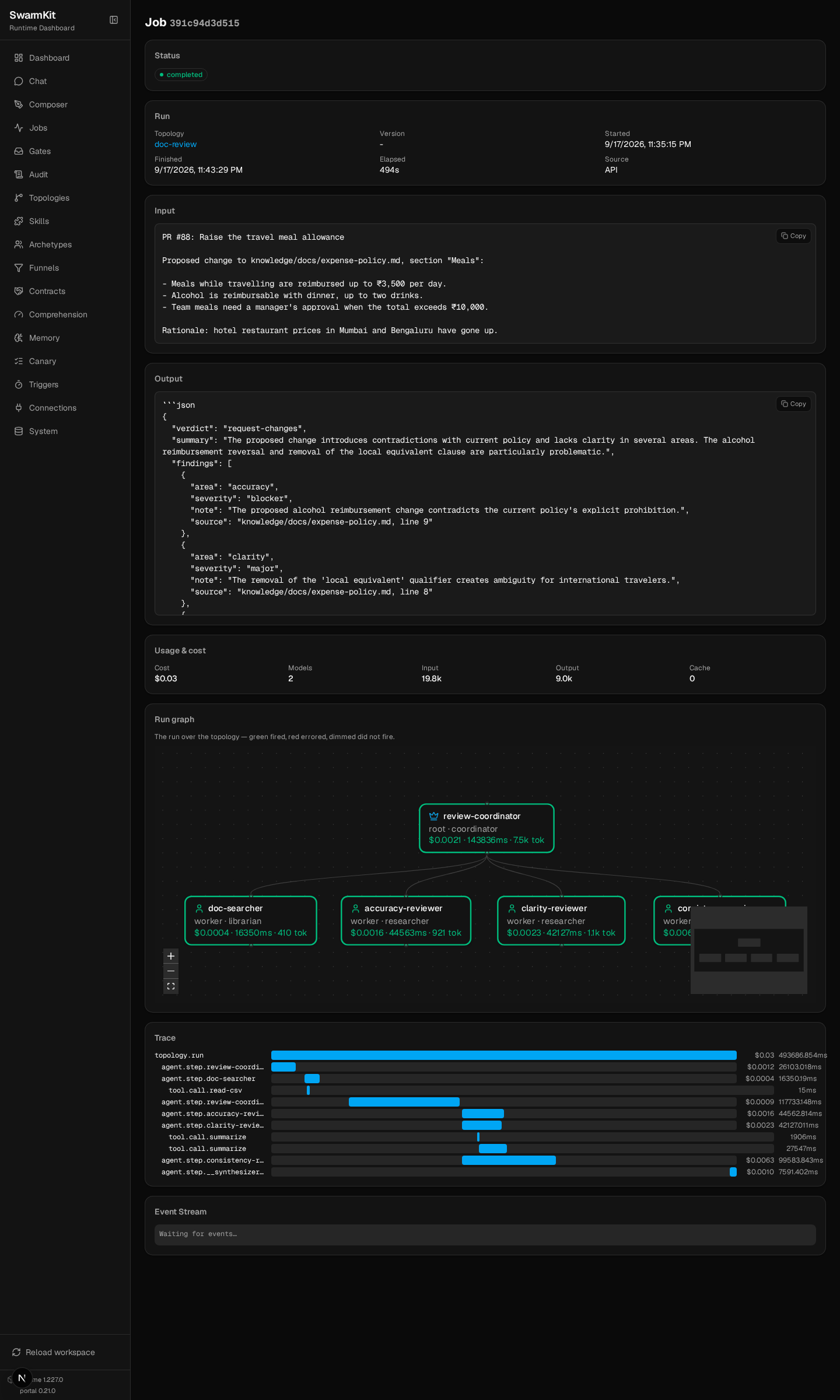
Every run, explained
Which agent fired, what each cost, the span waterfall, the exact prompt a model saw. trace, why, ask, debug from the terminal; the same on the job page.
Observability →
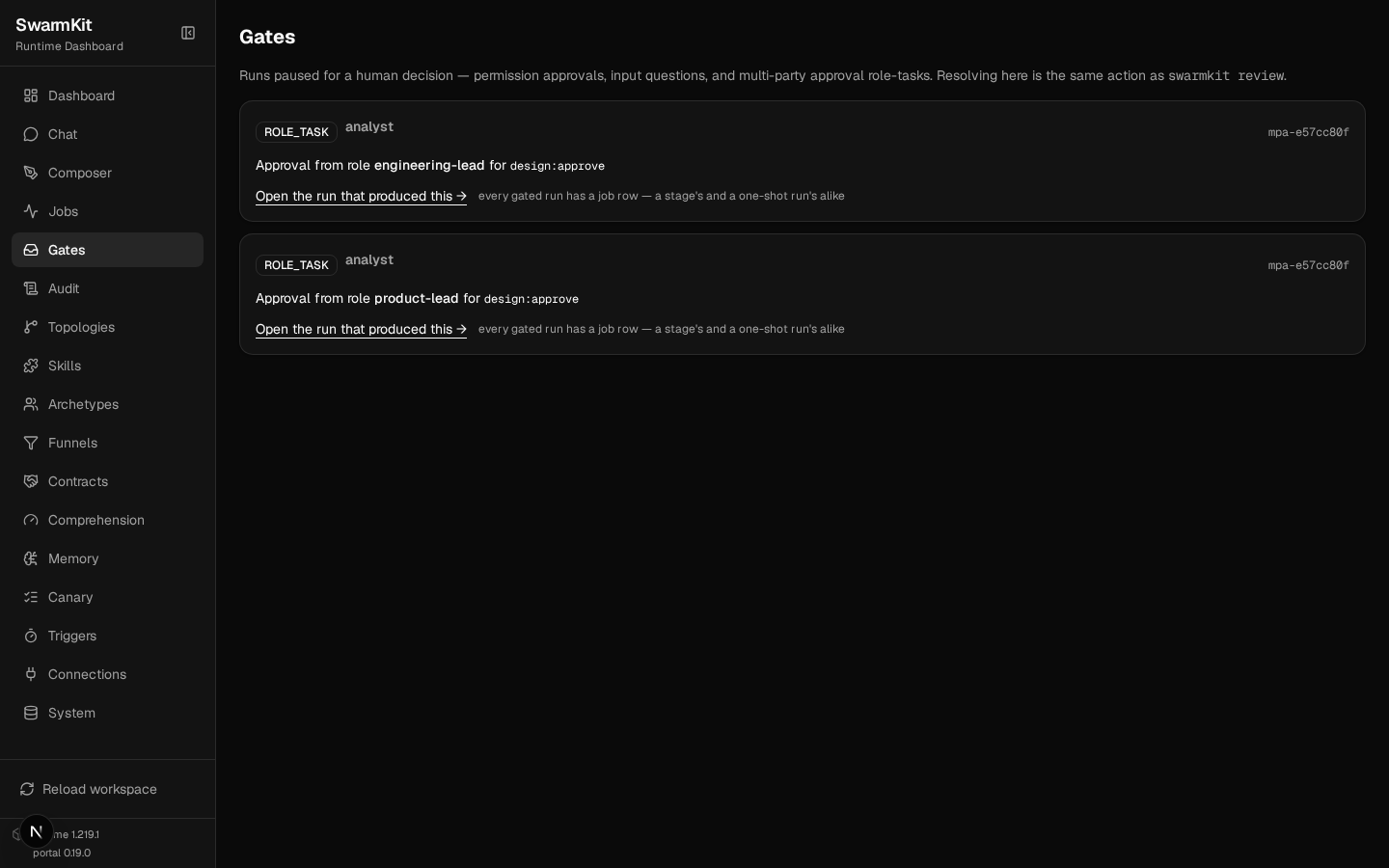
Gates that hold
Decision skills run before an agent sees input and after it answers. A funnel judges the artifact, then two named people approve — quorum enforced by the runtime, not the prompt. Governance →
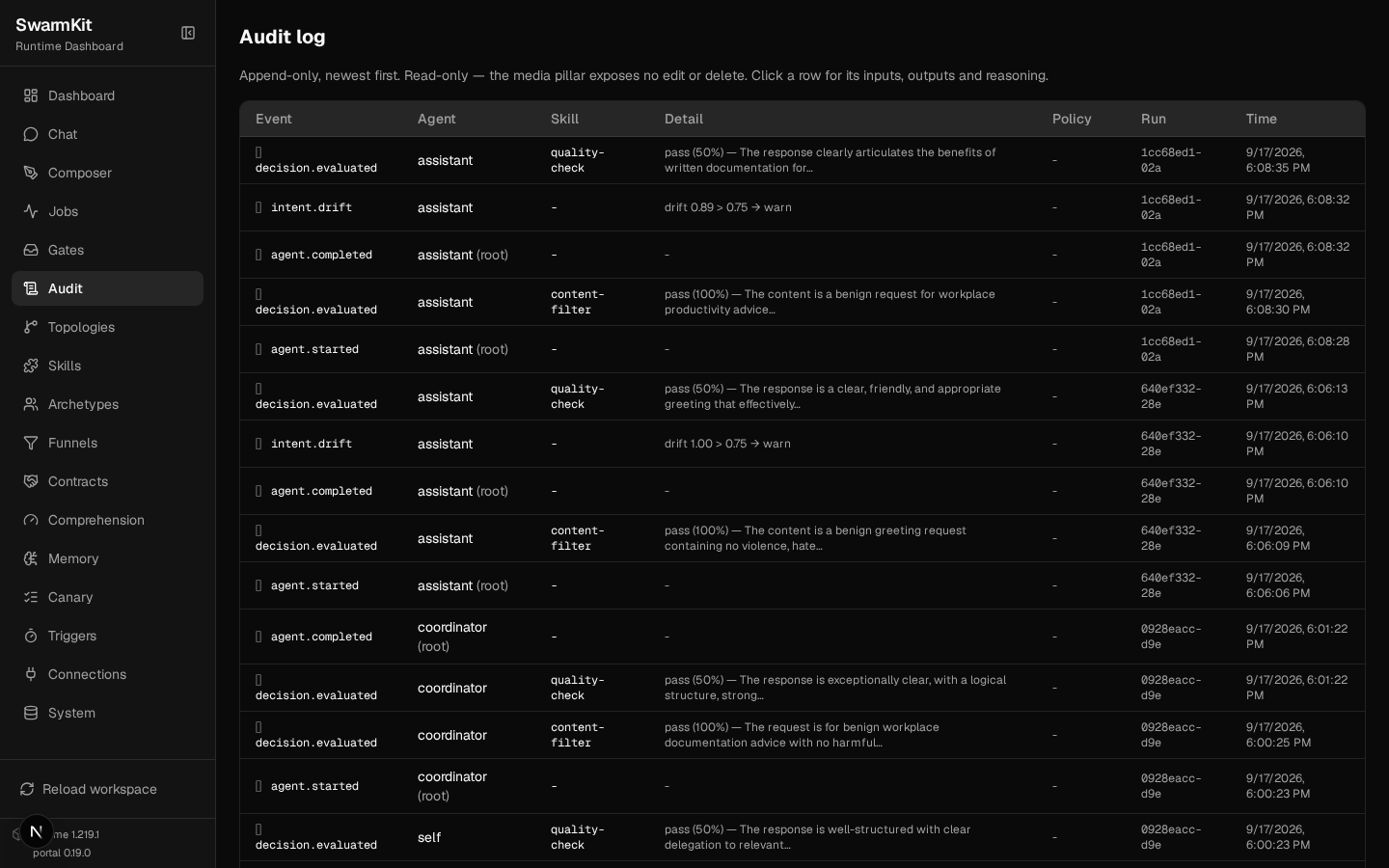
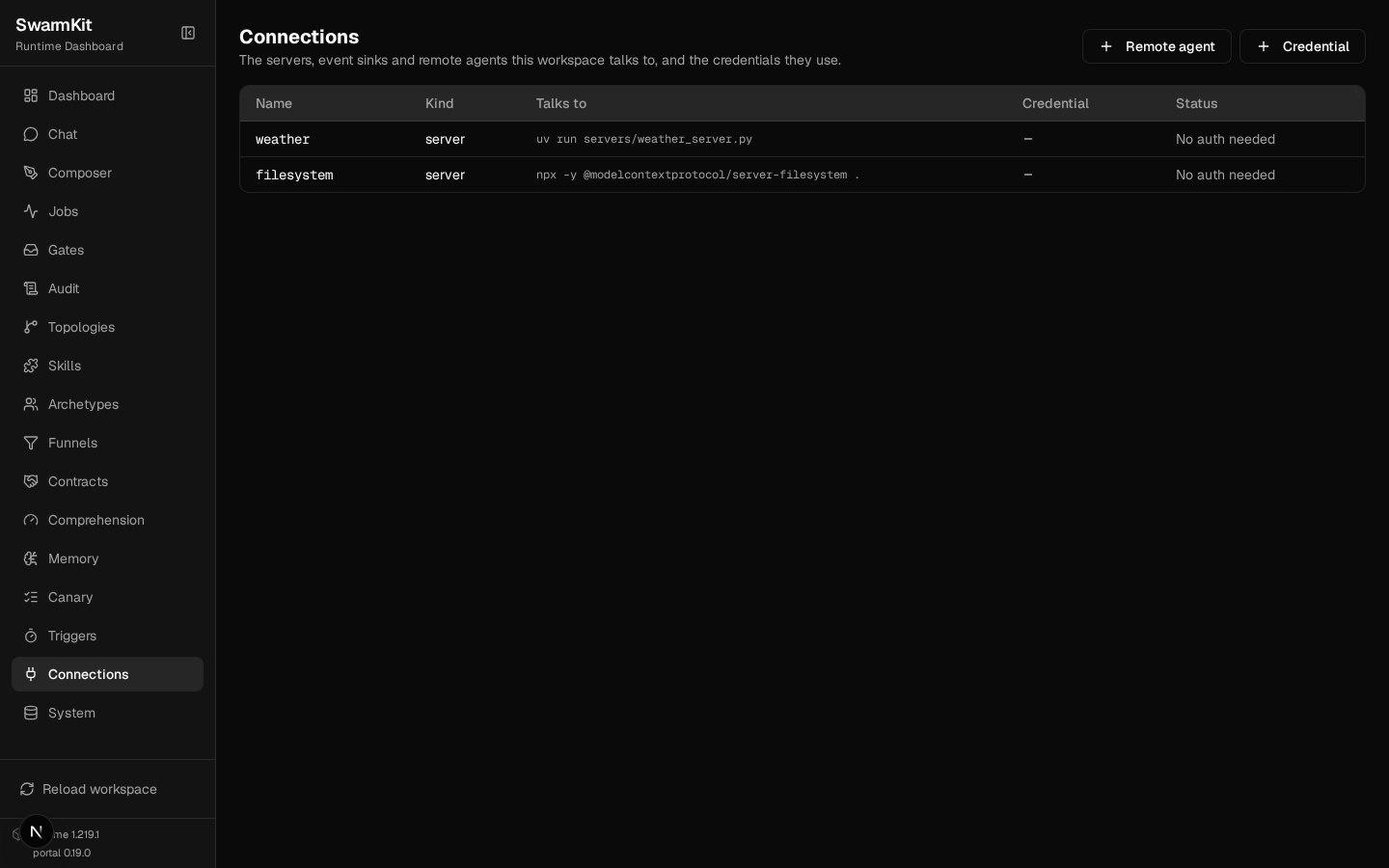
7,000+ tools, one config block
Any MCP server is a few lines of mcp_servers. Permission tiers, declared effects, sandboxing, credentials by reference — a readonly server cannot write, whatever the model asks.
MCP tools →
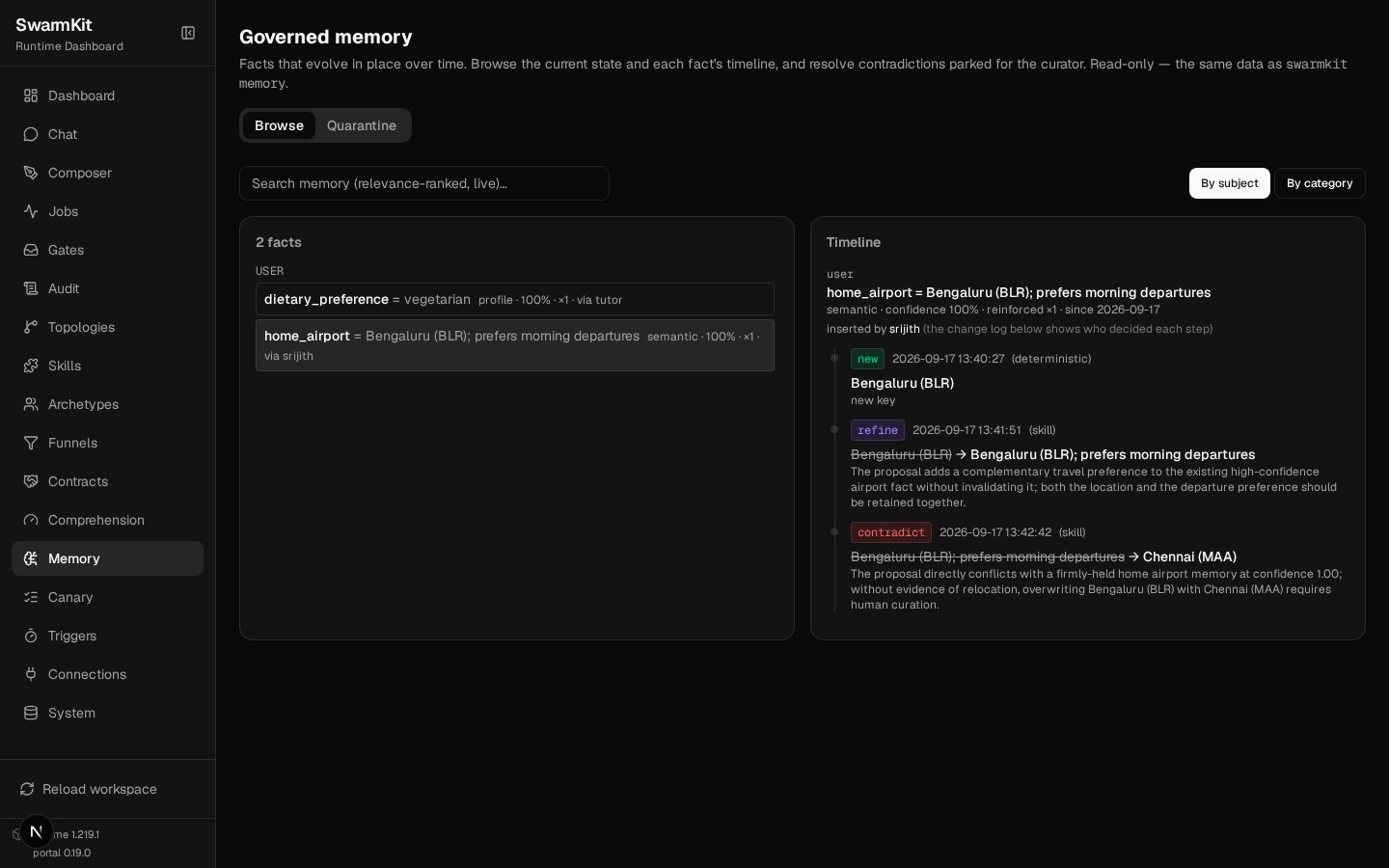
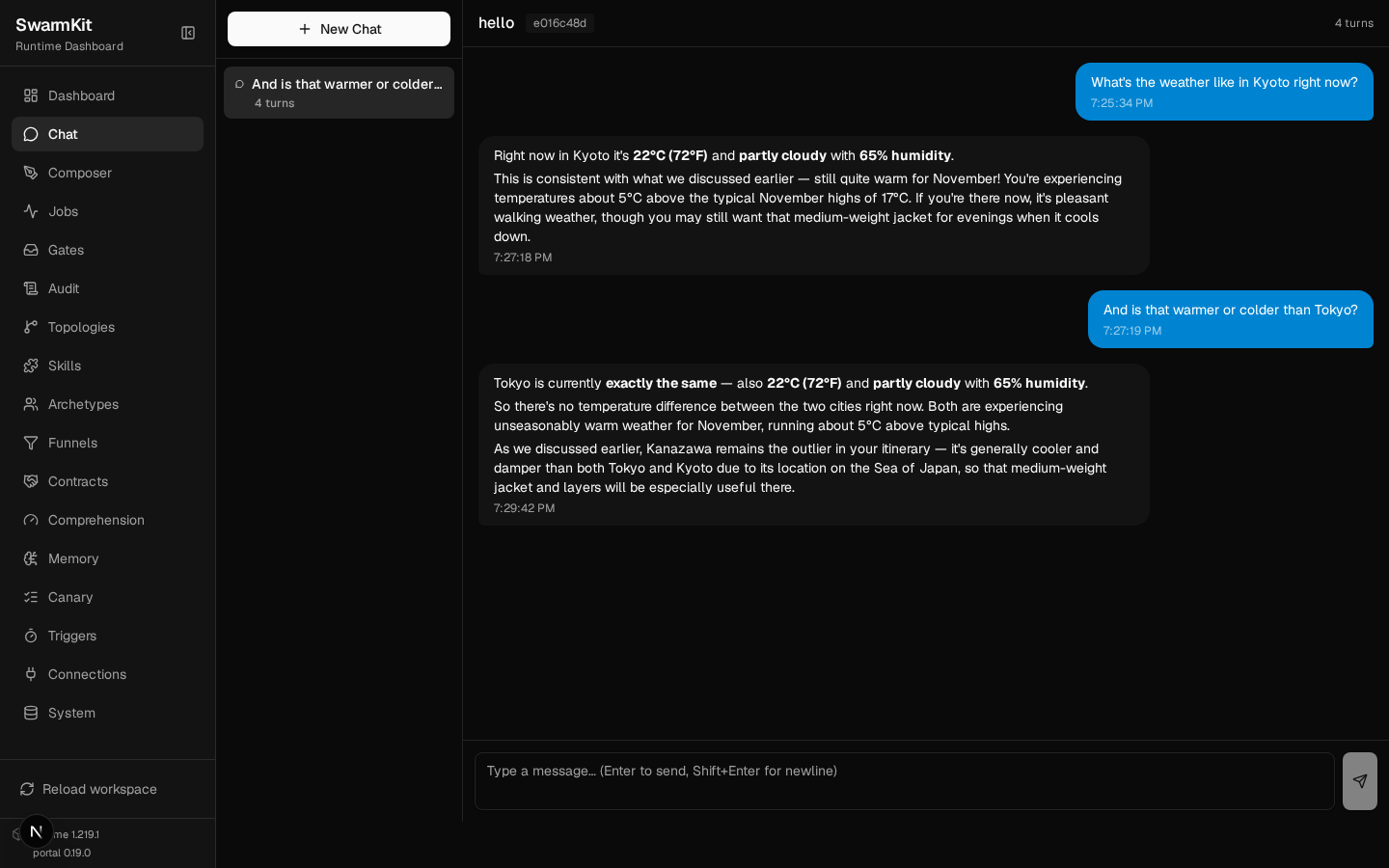
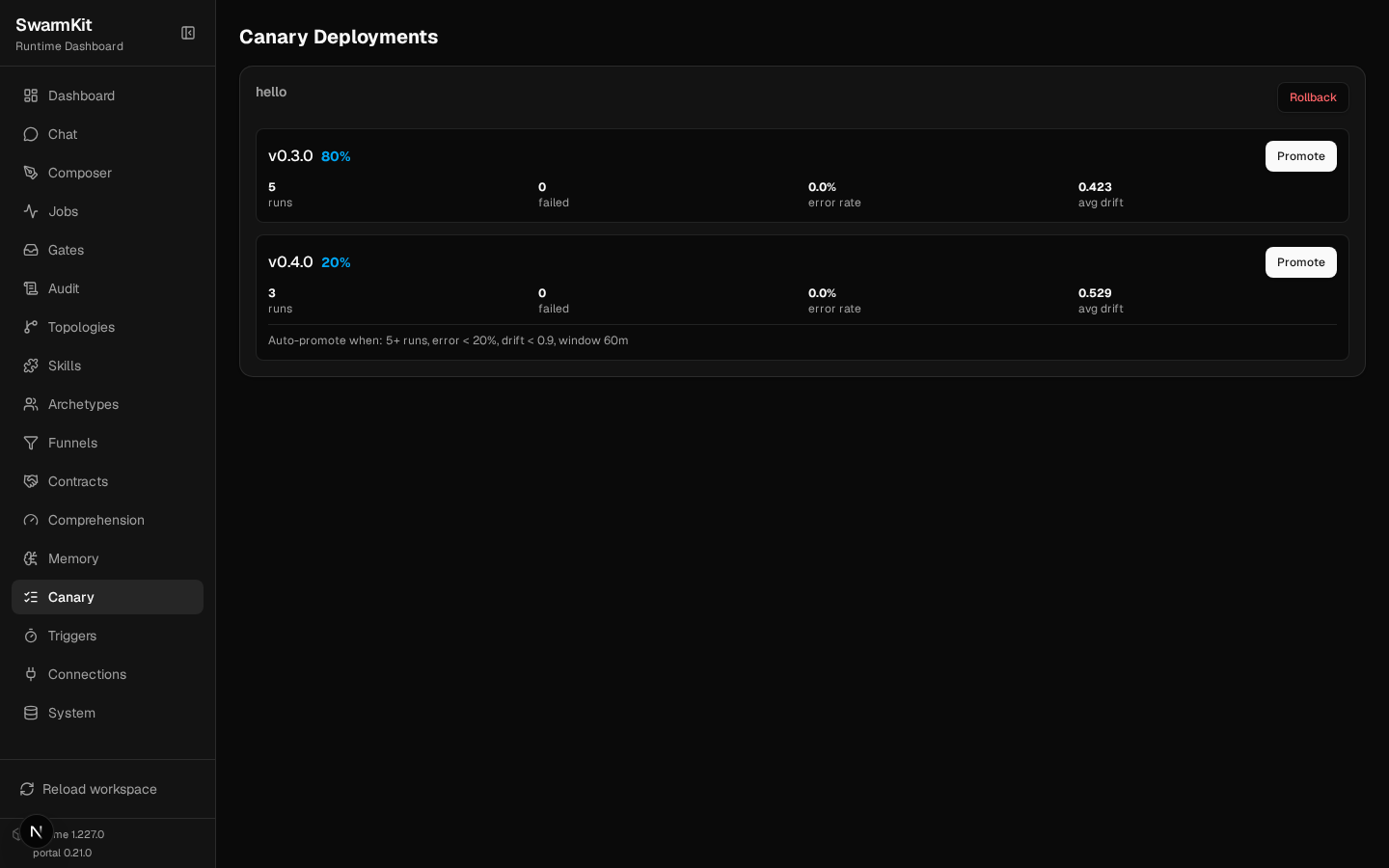
Ship a new version safely
Two versions of one topology side by side, traffic split by weight, promotion when the error rate and drift say so — or by hand, or rolled back. Cron and signed webhooks start runs on their own. Triggers & canary →
Grows by conversation
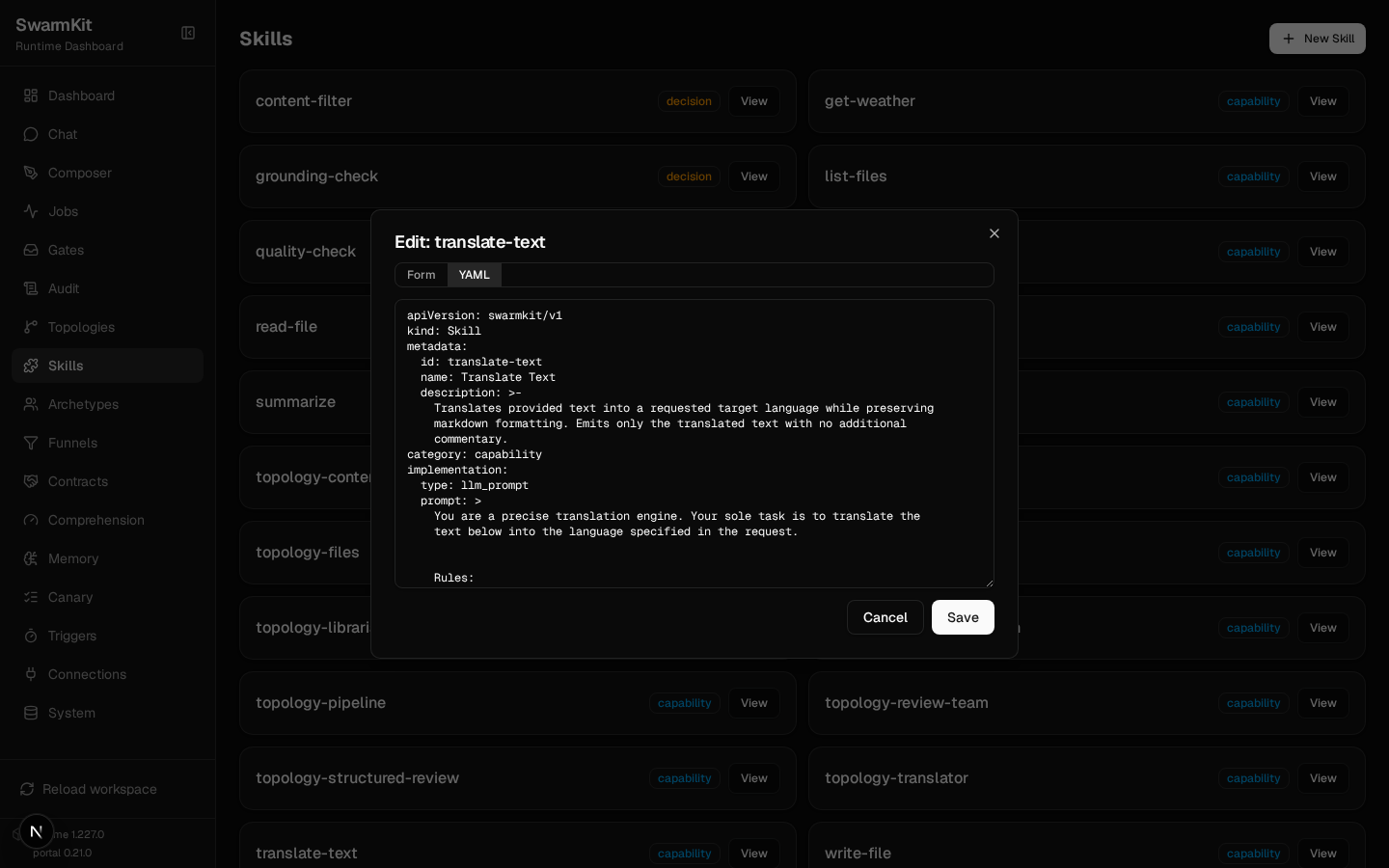
Describe a skill, a topology or a whole workspace; an agent drafts it, validates it against the schema, and writes it only after you say yes. Gaps an agent hits are logged for the next one. Authoring →
Thirty seconds to a running swarm
uv tool install "swarmkit-runtime[ui]" — the CLI and server, with the portal.
Or let swarmkit init write it from a sentence. A workspace is a directory of YAML.
swarmkit run . hello --input "…" — or swarmkit serve . and open the portal.
swarmkit trace, why, ask, debug. Then add a gate, a tool, a second agent.
curl -LsSf https://astral.sh/uv/install.sh | sh
uv tool install "swarmkit-runtime[ui]"   # [ui] is the portal; without it `swarmkit serve` is API-only
swarmkit init my-swarm            # a conversation; it writes the YAML
swarmkit run my-swarm hello --input "Say hello to the team."
swarmkit serve my-swarm           # the portal at http://127.0.0.1:8000
Watch it
Learn it in 22 levels
Every level builds on one workspace. Every transcript is a real run, every YAML block is validated and run in CI, every screenshot is the portal on that workspace.
Why not just write the code?
| SwarmKit | LangGraph (raw) | CrewAI | Claude Agent SDK | |
|---|---|---|---|---|
| Agent definition | YAML topology | Python code | Python classes | Code + config |
| Multi-agent orchestration | Declarative hierarchy + DAG + task plans | Manual graph construction | Role-based | Single agent loop |
| Tool integration | 7,000+ MCP servers via YAML | Build or wire yourself | Built-in + MCP | Built-in harness + MCP |
| Governance | Decision-skill gates, IAM scopes, circuit breakers, funnels | DIY | None | None |
| Human approval | Structural: quorum, roles, defer-and-resume | Manual interrupt points | None | None |
| Audit trail | Append-only, with reasoning | DIY | None | None |
| Observability | Trace, drift, OTel, why/ask, prompt ring buffer |
DIY | Minimal | Minimal |
| Lock-in | Open YAML + OSS runtime | N/A | Python classes | Vendor SDK |
| Models | 12 providers, declared as YAML | Any | Multiple | Claude only |
You keep LangGraph underneath — checkpointing, streaming, state — without writing its boilerplate, and the runtime records every step.
Built to be read by machines too
Docs are consumed by LLMs as much as by people. /llms.txt is the compact index; /llms-full.txt inlines the whole corpus. swarmkit knowledge-server serves the same corpus to Claude Code or Cursor over MCP, and swarmkit mcp-serve turns any workspace into tools an assistant can call.